

The Physics Behind
Measuring Excellence.
Invented in the 1970s, BIPM-recognized since 1976. ph-instruments makes it fully industrial for the first time.
Measurement Principle
The Spinning Rotor Gauge
A 4.5mm stainless steel ball is magnetically levitated in a sealed measuring tube and electromagnetically accelerated to 600 revolutions per second. Once spinning, it coasts freely in vacuum.
Gas molecules decelerate the ball at a rate precisely proportional to gas pressure. This deceleration (molecular drag) is measured via external coils — no feedthroughs, no filament. The accommodation coefficient σ deviates less than 1% from ideal — making the VIM-1 a fundamental gauge that does not drift as electronics age.
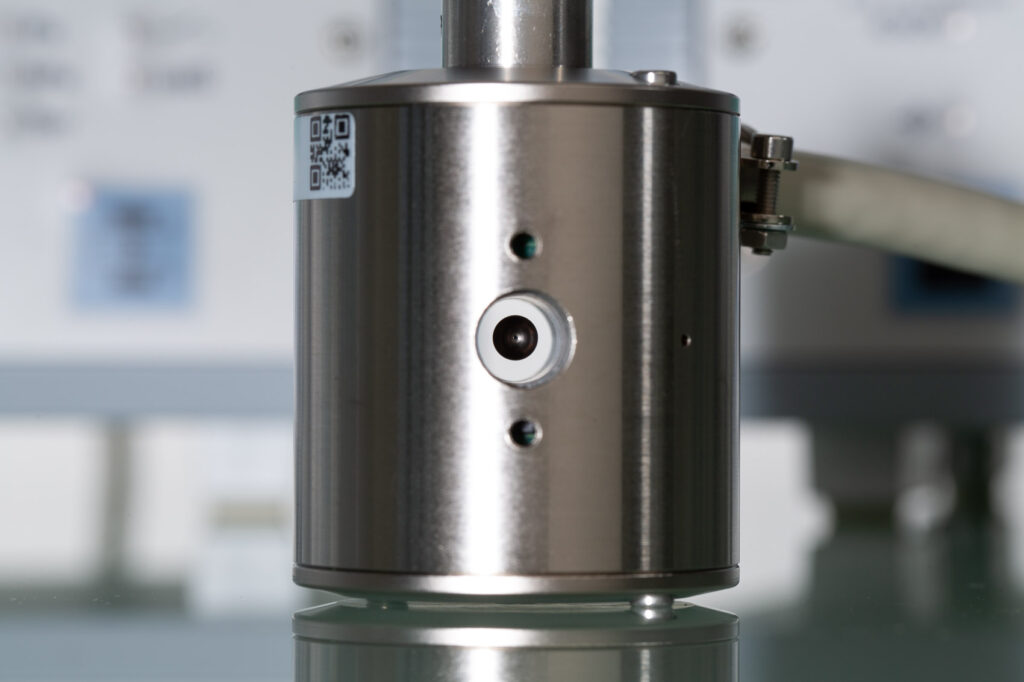
In Motion
How Molecular Drag
Becomes Pressure.
Gas molecules adsorb onto the polished steel surface, transfer their kinetic energy, and desorb in a thermalized random direction.The collective momentum transfer slows the ball — and the rate of deceleration is directly proportional to gas pressure. No filament. No ionization. Pure physics.
Head-to-Head
SRG vs. Capacitive Manometer vs. Ion Gauge
Three high-vacuum measurement principles, each with its own physics.
The SRG is the only one that delivers absolute accuracy with no drift, no filament, and no membrane sensitivity across the critical 10⁻⁴ to 10⁻⁶ mbar range.
| Parameter | Spinning Rotor Gauge (SRG) | Capacitive Manometer | Ion Gauge (Bayard-Alpert) |
|---|---|---|---|
| Measurement Principle | Molecular viscous drag — absolute | Membrane deflection — absolute | Ionization current — relative |
| Pressure Range | ✓ 10⁻² to 10⁻⁷ mbar | ~ 10³ to 10⁻⁴ mbar (limited) | 10⁻³ to 10⁻¹⁰ mbar |
| Accuracy (calibrated) | ✓ ±1% of reading | ✓ ±0.25–0.5% of reading | ✗ ±15–30% after drift |
| Annual Drift | ✓ <1.5% / year | ~ 1–5% / year (membrane) | ✗ 30–40% / year (MKS data) |
| Gas Independence | ✓ Compensable (√M) | ✓ Fully gas-independent | ✗ Multi-point per gas |
| Filament | ✓ None | ✓ None | ✗ Required — burns out, degasses |
| Coating Sensitivity | ✓ Zero — only ball diameter matters | ✗ High — coats membrane, shifts zero | ✗ High — shifts ionization rate |
| Membrane Bending / Zero Drift | ✓ Not applicable — no membrane | ✗ Yes — temperature-sensitive | ✓ Not applicable |
| Sensor Lifetime | ✓ >10 years (some 30+ years) | ~ 3–5 years typical | ✗ 2 weeks–6 months (HC implant) |
| Heated Operation Required | ✓ No — room temp | ✗ Yes — typically 45–200°C | ✓ No (filament heated, not body) |
| Electrical Feedthroughs | ✓ None — purely electromagnetic | ✗ Required — capacitor sensing | ✗ Required — potential leak path |
| Influences Vacuum | ✓ No — fully passive | ✓ No — passive | ✗ Yes — gettering, ionization, outgassing |
| Hydrogen Measurement | ✓ Yes — direct | ✓ Yes — gas-independent | ✗ Interference |
| Corrosive Gas Tolerance | ✓ Yes (BF₃, PH₃, etc.) | ~ Limited — Inconel/Hastelloy needed | ✗ Filament attacked |
| ARC / Plasma Sensitivity | ✓ Immune | ✓ Immune | ✗ Highly sensitive — filament damage |
| Calibration Standard | ✓ BIPM primary transfer standard | Reference — laboratory calibration | Relative — needs external reference |
Bottom Line
Capacitive manometers excel above 10⁻⁴ mbar with high precision — but lose performance in the high-vacuum regime due to membrane bending and zero drift.
Ion gauges reach into UHV but drift heavily, suffer from filament aging, and cannot measure hydrogen or process-aggressive gases reliably.
The SRG fills the gap: in the 10⁻⁴ to 10⁻⁶ mbar range — where most semiconductor and cryogenic applications operate — no other technology matches its accuracy, drift stability, and lifetime.